Think of a letter you have kept for years. Maybe it was a note from a grandparent, a card from your father, or a few lines written on the back of a photo. It probably was not long or polished. It mattered because someone took a moment to put their thoughts into words, for you.
A message for the future is exactly that, written now and opened later. It might be for your daughter's 18th birthday, your son's wedding, a grandchild who has not been born yet, or yourself in ten years. This guide covers what to write, how to say it, and how to make sure it reaches the right person at the right time.
Why write one at all?
Because the important things are usually the ones we never quite get around to saying. Life is busy, and conversations drift to schedules and errands. A future message gives you a quiet moment to say what you really mean, and gives the person receiving it something they can return to again and again.
You do not need perfect words. You need honest ones, in your own voice.
Start with a few simple prompts
A blank page is the hardest part. Pick one or two of these and start writing. You can always shape it later.
- What do I see in you right now that I hope you never lose?
- What was happening in our family when I wrote this?
- What is a memory of us together that makes me smile?
- What did I learn the hard way that I would like to spare you?
- What do I hope you will feel when you read this?
- What would I want you to know if I could not be there on this day?
Include small, specific details: the song you sang to them at bedtime, the name of their first school, the way they mispronounced "biscuit". Details are what make a message feel like you.
Examples for the moments that matter
These are starting points, not scripts. Change every word until it sounds like you.
For an 18th birthday
Eighteen is a threshold. Your child is becoming an adult, and you have watched every step. Share who they were as a little one, what you are proud of, and what you trust them to do with their freedom.
"Today you are eighteen. When I wrote this, you were nine and refused to wear anything but your dinosaur T-shirt. I hope you still keep your stubbornness for the things that deserve it. Whatever you choose next, you have a home to come back to."
For a wedding day
A wedding day is full and loud. A message gives them something private in the middle of it. Talk about love as you have lived it, a blessing for the life ahead, and perhaps a memory of your own wedding.
"Your grandfather and I argued about everything for forty years, and still he made my coffee every morning. Marriage is mostly the small things, done again and again. I am so happy for you both."
For a grandchild not yet born
This is one of the most beautiful messages you can write. You do not know their name yet, but you know the family they will be born into. Tell them about their parents as children, the house, the Christmases, and what you hope they inherit.
"I am writing this before you arrive. Your mother was the noisiest baby in our street, so I am preparing myself. Know that you were wanted and waited for, long before you came."
For your future self
Writing to yourself is a surprisingly honest exercise. Describe your life today, what you are worried about, and what you hope will have changed. Ask yourself a few questions you will only be able to answer later.
"Right now you are anxious about the move to Seattle. Did it work out? Did you keep calling your mother every Sunday? I hope you were kind to yourself through all of it."
Getting the tone right
- Write the way you speak. If you would say "sweetheart" or "kiddo", say it here too.
- Keep it warm, not heavy. A future message should feel like a gift, not an obligation. Avoid instructions and pressure.
- Short is fine. Half a page that sounds like you beats three pages that sound like a speech.
- Write for who they will be. An 18-year-old will read differently from the 10-year-old you know today.
Try a voice note or a video
Text is lovely, but your voice carries things words cannot: your laugh, your accent, the way you say their name. A short voice note or video is also easier for many elders than typing. Record in a quiet room, speak as if they are sitting in front of you, and do not worry about stumbles. Those small imperfections are what people treasure.
With FamRoot Future Messages, you can write a text, record a voice note or make a video, and schedule it for a date, a birthday, a wedding day, an anniversary or another milestone, including messages to your future self or to a future generation.
How delivery works on FamRoot
It helps to know exactly how a message reaches its person, so you can plan for it.
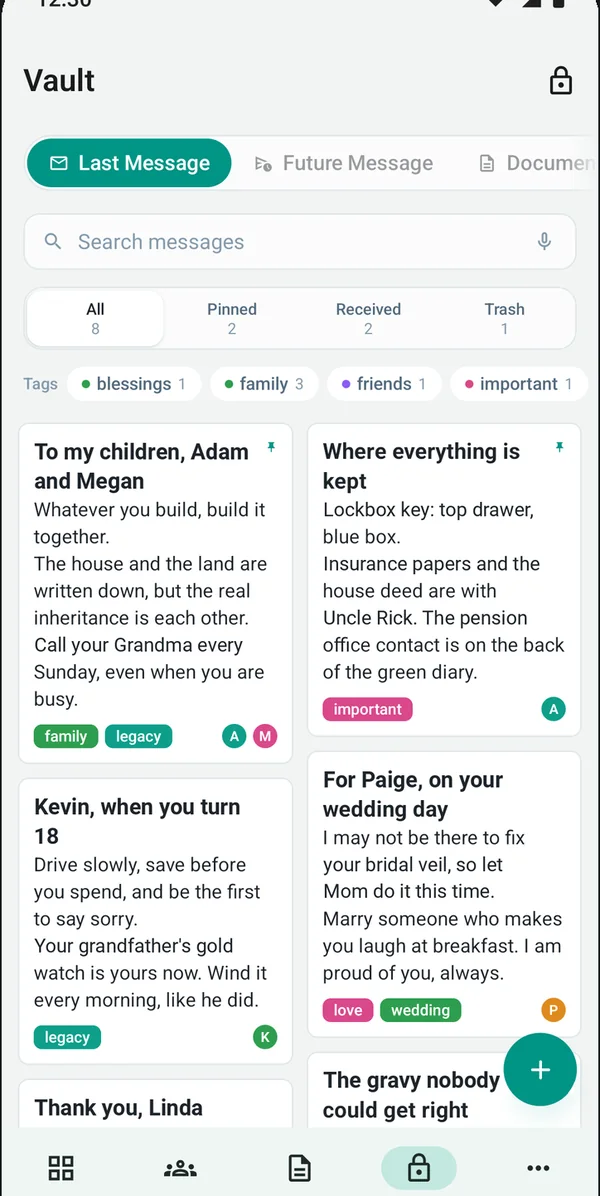
- Each message is attached to the recipient's family-member profile in your tree.
- It is delivered only once that profile becomes a FamRoot user. So inviting the person to join matters.
- A message for someone not yet born waits until their profile is added to the tree and becomes a user.
- You can edit or delete a message at any time before it is delivered.
- If you delete your FamRoot account, all your future and last messages are deleted too.
Writing a last message
A last message is different. It is meant to be read after you are gone. It is not easy to write, but many people find it brings real peace of mind.
Some things people choose to include:
- Thanks, said plainly, for specific things.
- Forgiveness, asked for or offered.
- A favourite memory with that person.
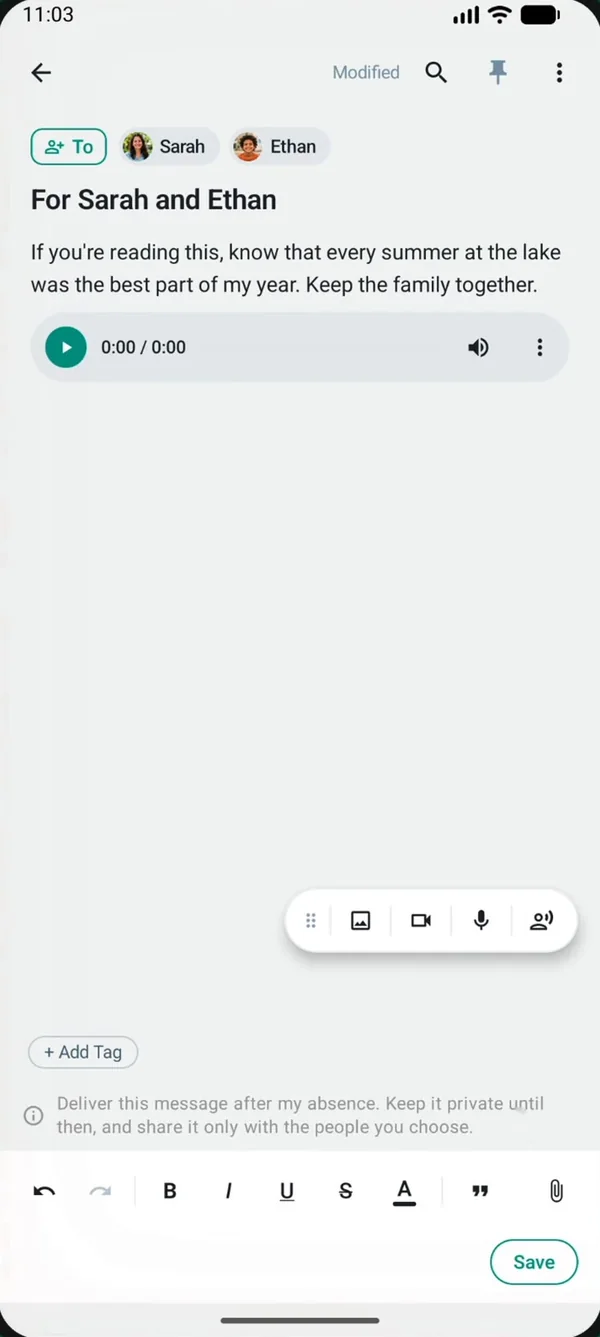
- Practical reassurance, such as where important papers are kept.
- Permission to grieve, and permission to be happy again.
With FamRoot Last Message, you can leave a text, voice note, photo, video clip or document for one or more people in your circle. Last messages are encrypted with AES-256. They are released only after a verified death report: someone from your closest family (parents, children or siblings) reports it, two people from that circle must acknowledge it, and all of them are notified. Once the report is verified, your messages go to the people you chose in advance.
When to update your messages
A message written today may not fit in five years. Revisit them now and then, especially after:
- A birth, marriage or death in the family.
- A move, a new job or a major illness.
- A reconciliation, or a falling-out.
- A milestone birthday of your own.
A simple habit works well: look over your messages once a year, perhaps on your birthday or at New Year. Both future and last messages on FamRoot can be edited or deleted at any time.
Start with one
You do not need to write to everyone at once. Choose one person and one day. Write a few honest lines, or record two minutes on your phone. That single message may become one of the most treasured things you ever give.
Write your first message today. FamRoot is free, and the Vault includes 1 GB of storage for every user. Sign up for free, and we will email you an invite once your sign-up is approved.