
Most people decide to build a family tree after a moment that catches them off guard. A wedding where you met a dozen relatives and could not place any of them. A grandparent's story you wish you had written down. A child asking, "Who is Uncle Thomas's son, exactly?"
The good news is that you do not need to be a genealogist. You need a starting point, a few good conversations, and a simple way to keep track of what you learn. This guide walks through how to build a family tree that is accurate, respectful and, most importantly, kept up to date by the family itself.
Start with yourself, then work outwards
It is tempting to begin with the most distant ancestor anyone remembers. Resist that. Start with the people you know best, because that is where your information is most reliable.
- You, with your spouse and children if you have them.
- Your parents and siblings. This is your closest circle, and the base everything else connects to.
- Your grandparents on both sides, and their children (your aunts and uncles).
- Cousins and their families, then in-laws, then further branches.
Working outwards one generation at a time keeps the tree connected. Every new person attaches to someone already there, which makes mistakes easier to spot.
Talk to your elders, and talk soon
Records can tell you a name and a date. Only people can tell you that your grandfather walked three miles to school every day, or that a great-aunt was raised by her mother's sister. Your elders are the most valuable source you have, and their memories will not wait.
How to make the conversation easy
- Bring something to look at. An old photo album or a wedding invitation sparks memories far better than a list of questions.
- Ask open questions. "Tell me about your brothers and sisters" works better than "How many siblings did you have?"
- Go branch by branch. One sitting for your mother's side, another for your father's. Short sessions are kinder and more productive.
- Record it, with permission. A voice recording lets you check details later and keeps their voice for the family.
- Note who told you what. When two relatives remember things differently, knowing the source helps.
Every family has one person who knows how everyone is connected. Make sure that knowledge does not live only in their head.
What details to collect
A useful family tree is about more than names. For each person, try to collect:
- Full name, plus the name the family actually uses (more on this below).
- Relationship to the people already in the tree: parents, spouse, children.
- Date of birth, or an approximate year if no one is sure.
- Where they live or lived. The town someone grew up in often matters as much as the city they live in now.
- A current phone number for living relatives, so you can stay in touch and invite them.
- A photo, if one exists.
Do not let gaps stop you. "Born around 1940, somewhere near Boston" is far more useful than leaving someone out because you lack an exact date. You can fill in details as you learn them.
Names need special care
Naming habits vary from family to family, and a family tree should reflect that rather than force everyone into one format.
- The same name across generations. Many families have a William in every generation, or a father and son who share a full name. Record a birth year or a "Sr." and "Jr." so nobody confuses the two.
- Surnames that change. Many people change their surname after marriage, and some families hyphenate or use both. Record the name before marriage too, because that is how older relatives will remember her.
- Kinship names. Relatives are often known as Grandma, Nana, Pop or Aunt Grace rather than by their full name. Note both, so younger family members can connect the two.
- Nicknames. "Bill", "Peggy" or "Jamie" might be the only name half the family knows. Write it down.
- Spelling. The same name may be spelt three ways in three documents. Pick the one the person uses, and note the others.
Handling multiple marriages and adoptions respectfully
Real families are rarely a neat diagram. People remarry after a divorce or the death of a spouse. Children are adopted, raised by grandparents, or brought up by an aunt as her own. A good family tree has room for all of this.
- Record what is true, not what is tidy. A second marriage is part of the family's story, and so are the children from each marriage.
- Follow the family's lead on adoption. Some families want an adoption recorded openly, others consider it private. Ask the people involved how they would like to be shown.
- Be gentle with sensitive history. Estrangements, separations and early deaths can be painful. You can record the relationship without recording every detail.
- Let people describe themselves. Wherever possible, invite each person to check and complete their own entry.
FamRoot's family tree supports spouses, adoptions and multiple marriages across multiple generations, so you can show relationships as they really are.
Build it together, not alone
The most common reason family trees fail is that one person builds them, and when that person gets busy, the tree stops. Births, marriages and new phone numbers never make it in.
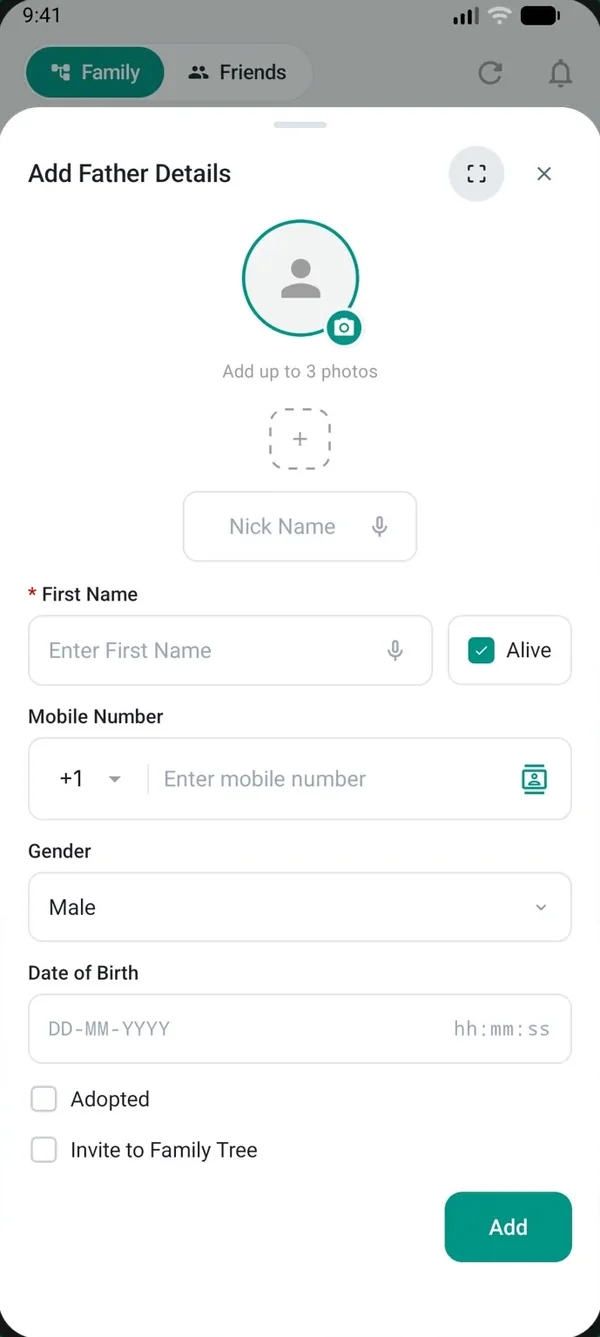
The fix is to share the work. This is the idea behind FamRoot, a family tree app built as a living network. You add your closest family, and each relative you add can be invited to join. An invite is selected by default, so they receive an SMS with a link. Once they join, they can add their own spouse, children and in-laws, the branches they know best. Every member of the tree is a moderator. Existing members approve who joins next, so the tree stays in the family's hands, not one person's.
Because many people now contribute, FamRoot also protects against accidental changes. Anyone in the tree can request an edit or removal of a relationship, and if the tree has more than one user, at least one other user must approve it.
Keep it current
A family tree is never finished, and that is a good thing. A few simple habits keep it accurate:
- Add new babies and new spouses soon after the event, while everyone is talking about it.
- Update phone numbers and cities when relatives move.
- Add a location on FamRoot, either by typing an address or pinning it on a map, so relatives can be found by place or distance. It is only as precise as what you enter.
When everyone keeps their own corner current, the tree becomes something the family uses in daily life, not a chart that sits in a drawer. If you are on Android, FamRoot's Smart Caller ID will even use the tree to show how a caller is related to you, once the Android app launches.
Privacy: a family tree is personal data
Names, birthdays, relationships and phone numbers are exactly the kind of information that should not be public. Before you share a family tree anywhere, ask who can see it.
- Avoid posting a full tree with dates of birth on open social media.
- Ask living relatives before adding their contact details, and respect a "no".
- Choose a tool where the tree is private by default.
On FamRoot there is no public link to your tree. Content is visible to relatives connected within seven relationship levels and to people in your circle. Friends you add see your profile, not your tree. If someone finds their details on FamRoot and does not want to be listed, they can email support@famroot.com and we will remove them and make sure they are not added again. Read more on our Data & Security page.
One practical note: FamRoot does not currently import or export family tree files, so if you have a tree in another tool, you will add people by hand.
Your first ten minutes
If this all feels like a lot, start small. Add yourself, your parents, your siblings and your grandparents. Invite one relative who loves family history. That is enough to get the tree growing.
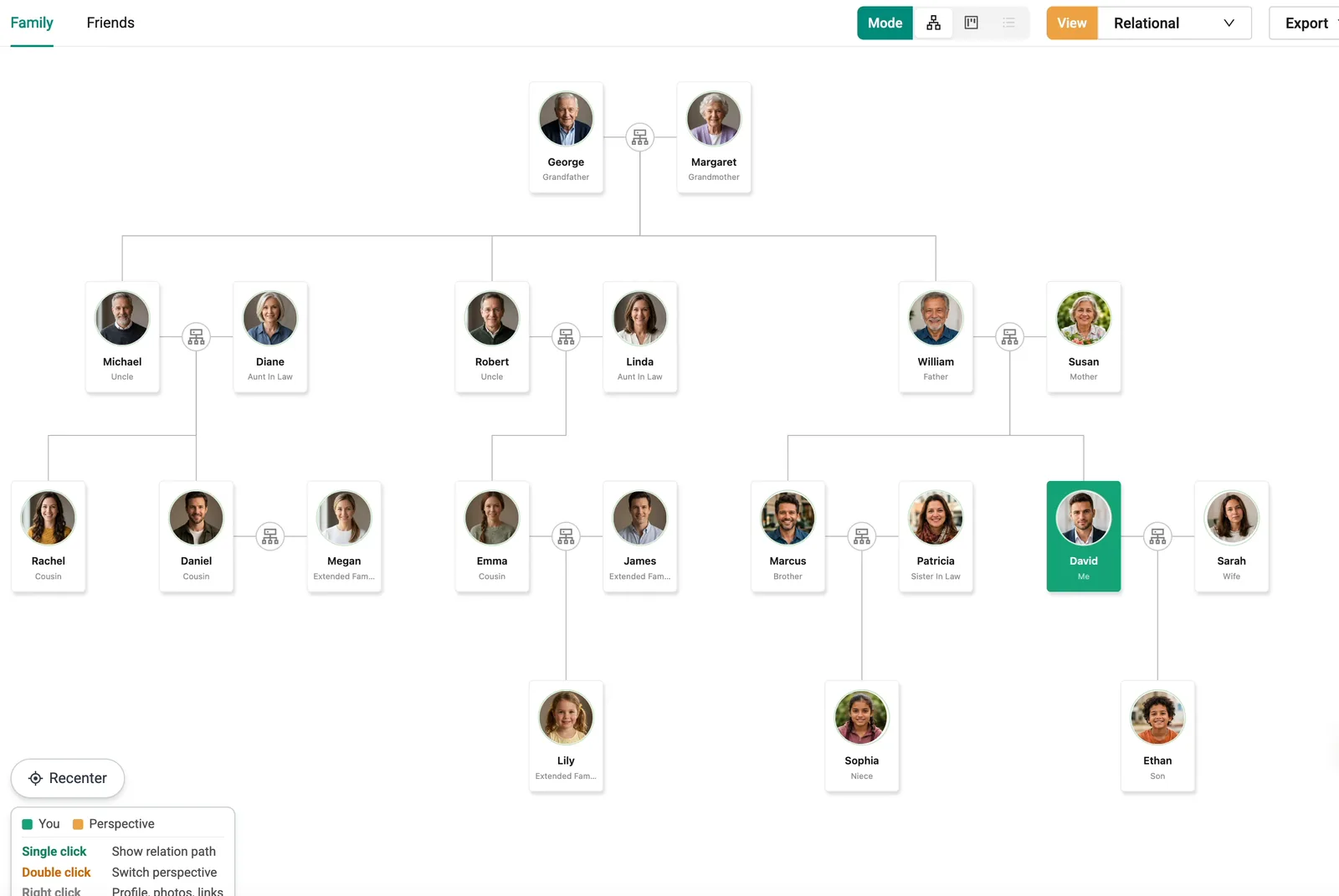
Start building your family tree. FamRoot is free, works on the web today, and grows as your family joins in. Sign up for free, and we will email you an invite once your sign-up is approved.