
English gets by with about twenty family relationship names. Hindi, Tamil, Telugu and Kannada each need many more, because they say whether a sibling is older or younger and whether a relative is on your mother's side or your father's. Chacha, tau, mama and phupha are all "uncle" in English; in Hindi they are four different men. This chart puts the common words side by side so you can read any Indian family tree, whichever language the family speaks at home.
Every entry below was checked against at least two dictionaries or university language courses (the full list is in the sources). Spelling and pronunciation vary by region, caste and family, so treat the chart as the most widely used form, not the only one. Where a word could not be confirmed, we have written "varies by family" rather than guess.
- Elder or younger matters. All four languages have separate words for an elder and a younger sibling, and the words for parents' siblings change with their age relative to the parent.
- Mother's side or father's side matters. English "uncle", "aunt", "grandparent" and "cousin" each split into several words.
- In the South, cousins are either siblings or in-laws. Tamil, Telugu and Kannada call father's brother's children and mother's sister's children brothers and sisters, and use the in-law words for father's sister's children and mother's brother's children. That is why Indian English has "cousin brother" and "cousin sister".
Immediate family
Formal and spoken forms are both listed where they differ. "Anna", "akka", "bhaiya" and "didi" are also used for unrelated older people, which is why a shopkeeper in Chennai may be anna to his customers.
| English | Hindi | Tamil | Telugu | Kannada |
|---|---|---|---|---|
| Father | पिता (pitā) / पापा (pāpā) | அப்பா (appā); formal தந்தை (tandai) | నాన్న (nānna); formal తండ్రి (taṇḍri) | ಅಪ್ಪ (appa); formal ತಂದೆ (tande) |
| Mother | माँ (mā̃) / माता (mātā) | அம்மா (ammā); formal தாய் (tāy) | అమ్మ (amma); formal తల్లి (talli) | ಅಮ್ಮ (amma); formal ತಾಯಿ (tāyi) |
| Elder brother | बड़ा भाई (baṛā bhāī) / भैया (bhaiyā) | அண்ணன் (aṇṇan), addressed அண்ணா (aṇṇā) | అన్న / అన్నయ్య (anna / annayya) | ಅಣ್ಣ (aṇṇa) |
| Younger brother | छोटा भाई (chhoṭā bhāī) | தம்பி (tambi) | తమ్ముడు (tammuḍu) | ತಮ್ಮ (tamma) |
| Elder sister | बड़ी बहन (baṛī bahan) / दीदी (dīdī) | அக்கா (akkā) | అక్క / అక్కయ్య (akka / akkayya) | ಅಕ್ಕ (akka) |
| Younger sister | छोटी बहन (chhoṭī bahan) | தங்கை (taṅgai); spoken தங்கச்சி (taṅgachi) | చెల్లి / చెల్లెలు (chelli / chellelu) | ತಂಗಿ (taṅgi) |
| Son | बेटा (beṭā) / पुत्र (putra) | மகன் (magan); spoken பையன் (paiyan) | కొడుకు (koḍuku) | ಮಗ (maga) |
| Daughter | बेटी (beṭī) / पुत्री (putrī) | மகள் (magaḷ); spoken பொண்ணு (poṇṇu) | కూతురు (kūturu) | ಮಗಳು (magaḷu) |
| Husband | पति (pati) | கணவன் (kaṇavan); spoken புருஷன் (puruṣan) | భర్త (bharta); spoken మా ఆయన (mā āyana) | ಗಂಡ (gaṇḍa) |
| Wife | पत्नी (patnī) | மனைவி (manaivi); spoken பொண்டாட்டி (poṇḍāṭṭi) | భార్య (bhārya); spoken మా ఆవిడ (mā āviḍa) | ಹೆಂಡತಿ (heṇḍati) |
Grandparents and grandchildren
Hindi is the odd one out here. It has separate words for father's parents (dada, dadi) and mother's parents (nana, nani), and for a son's children (pota, poti) and a daughter's children (nati, natin). Tamil and Kannada use one word for a grandfather on either side. Telugu uses one word for grandfathers but two for grandmothers.
| English | Hindi | Tamil | Telugu | Kannada |
|---|---|---|---|---|
| Paternal grandfather | दादा (dādā) | தாத்தா (tāttā) | తాత / తాతయ్య (tāta / tātayya) | ಅಜ್ಜ (ajja) / ತಾತ (tāta) |
| Paternal grandmother | दादी (dādī) | பாட்டி (pāṭṭi) | నానమ్మ / నాయనమ్మ (nānamma / nāyanamma) | ಅಜ್ಜಿ (ajji) |
| Maternal grandfather | नाना (nānā) | தாத்தா (tāttā) | తాత / తాతయ్య (tāta / tātayya) | ಅಜ್ಜ (ajja) / ತಾತ (tāta) |
| Maternal grandmother | नानी (nānī) | பாட்டி (pāṭṭi) | అమ్మమ్మ (ammamma) | ಅಜ್ಜಿ (ajji) |
| Grandson | पोता (potā, son's son) / नाती (nātī, daughter's son) | பேரன் (pēran) | మనవడు (manavaḍu) | ಮೊಮ್ಮಗ (mommaga) |
| Granddaughter | पोती (potī, son's daughter) / नातिन (nātin, daughter's daughter) | பேத்தி (pētti) | మనవరాలు (manavarālu) | ಮೊಮ್ಮಗಳು (mommagaḷu) |
Tamil families do have spoken forms that separate the two grandmothers (அப்பத்தா for father's mother, அம்மம்மா for mother's mother), but பாட்டி is the standard word, and Paati is what most children call both. Some Telugu families use తాతయ్య for father's father and తాత for mother's father.
Uncles and aunts
This is the section people search for most. Notice the pattern in the three southern languages: father's elder brother is literally "big father" (periyappa, peddananna, doddappa) and his younger brother is "small father" (chittappa, chinnanna, chikkappa). Mother's sisters are "big mother" and "small mother" in the same way. These are parallel relatives, and the language treats them as extra parents.
| English | Hindi | Tamil | Telugu | Kannada |
|---|---|---|---|---|
| Father's elder brother | ताऊ (tāū) / ताया (tāyā) / बड़े पापा | பெரியப்பா (periyappā) | పెద్దనాన్న (peddanānna) | ದೊಡ್ಡಪ್ಪ (doḍḍappa) |
| Father's younger brother | चाचा (chāchā) | சித்தப்பா (chittappā) | చిన్నాన్న (chinnānna) / బాబాయి (bābāyi) | ಚಿಕ್ಕಪ್ಪ (chikkappa) |
| Father's sister | बुआ (buā) / फूफी (phūphī) | அத்தை (attai) | అత్త / అత్తయ్య (atta / attayya); మేనత్త (mēnatta) for the blood aunt | ಅತ್ತೆ (atte); ಸೋದರತ್ತೆ (sōdaratte) for the blood aunt |
| Mother's brother | मामा (māmā) | மாமா (māmā) / தாய்மாமன் (tāy-māman) | మామ / మామయ్య (māma / māmayya); మేనమామ (mēnamāma) for the blood uncle | ಮಾವ (māva); ಸೋದರಮಾವ (sōdaramāva) for the blood uncle |
| Mother's sister | मौसी (mausī) | பெரியம்மா (periyammā, elder) / சித்தி (chitti, younger) | పెద్దమ్మ (peddamma, elder) / పిన్ని (pinni) or చిన్నమ్మ (chinnamma, younger) | ದೊಡ್ಡಮ್ಮ (doḍḍamma, elder) / ಚಿಕ್ಕಮ್ಮ (chikkamma, younger) |
| Father's brother's wife | ताई (tāī, elder brother's wife) / चाची (chāchī, younger brother's wife) | பெரியம்மா (elder) / சித்தி (younger) | పెద్దమ్మ (elder) / పిన్ని (younger) | ದೊಡ್ಡಮ್ಮ (elder) / ಚಿಕ್ಕಮ್ಮ (younger) |
| Mother's brother's wife | मामी (māmī) | மாமி (māmi) | అత్త / అత్తమ్మ (atta / attamma) | ಅತ್ತೆ (atte) |
| Father's sister's husband | फूफा (phūphā) | மாமா (māmā) / அத்திம்பேர் (attimbēr) | మామ / మామయ్య (māma / māmayya) | ಮಾವ (māva) |
| Mother's sister's husband | मौसा (mausā) | பெரியப்பா (elder) / சித்தப்பா (younger) | varies by family | ದೊಡ್ಡಪ್ಪ (elder) / ಚಿಕ್ಕಪ್ಪ (younger) |
Why does Hindi have four words for uncle?
Because Hindi names an uncle by the route to him. Chacha is your father's younger brother and tau is your father's elder brother. Mama is your mother's brother. Phupha is your father's sister's husband and mausa is your mother's sister's husband. Each has a matching wife: chachi, tai, mami, bua (father's sister) and mausi (mother's sister). The same logic carries into cousin names: a chachera bhai is a brother "via chacha", a mamera bhai is a brother via mama, a phuphera bhai via bua, and a mausera bhai via mausi.
In English, the single word "uncle" hides all of that. On a family tree, though, the route is exactly what matters, which is why a chart that only says "Uncle" beside a name in a Pune family tells you almost nothing about where he sits.
Why is the word for mother's brother the same as father-in-law in Tamil?
In Tamil, மாமா (māmā) is your mother's brother, your father's sister's husband and, in spoken use, your father-in-law. Telugu మామ and Kannada ಮಾವ work the same way. On the female side, Tamil அத்தை (attai), Telugu అత్త and Kannada ಅತ್ತೆ cover father's sister and mother-in-law.
The reason is the Dravidian kinship system, which Tamil, Telugu and Kannada all follow. Your father's brother's children and your mother's sister's children (parallel cousins) count as your brothers and sisters, and marriage with them is treated as incest. Your father's sister's children and your mother's brother's children (cross cousins) are the "true" cousins and, traditionally, the category a spouse could come from. If your mother's brother's daughter is a possible wife, then your mother's brother is a possible father-in-law, and the language simply uses one word for both. The mother's brother also has a special ritual role in South Indian families, which keeps the word in daily use. This custom is regional and declining, and we cover it more carefully in our post on cousin relationships.
Hindi takes the opposite view. All four kinds of cousin are equally non-marriageable, so bua is simply bua and has nothing to do with the word for mother-in-law (saas).
In-laws
The in-law words are where the four languages differ most and where family usage varies most. Hindi marks a husband's elder brother (jeth) and younger brother (devar) separately; their wives are your jethani and devrani. The Hindi word for wife's brother, sala, is also a common insult, so people say "sale sahab" or use his name with "ji".
| English | Hindi | Tamil | Telugu | Kannada |
|---|---|---|---|---|
| Son's wife (daughter-in-law) | बहू (bahū); also पतोहू (patohū) | மருமகள் (marumagaḷ) | కోడలు (kōḍalu) | ಸೊಸೆ (sose) |
| Daughter's husband (son-in-law) | दामाद (dāmād) | மருமகன் (marumagan) / மாப்பிள்ளை (māppiḷḷai) | అల్లుడు (alluḍu) | ಅಳಿಯ (aḷiya) |
| Father-in-law (husband's or wife's father) | ससुर (sasur) | மாமனார் (māmanār); spoken மாமா | మామ / మామగారు (māma-gāru) | ಮಾವ (māva) |
| Mother-in-law (husband's or wife's mother) | सास (sās) | மாமியார் (māmiyār); spoken அத்தை / மாமி | అత్త / అత్తయ్య (atta / attayya) | ಅತ್ತೆ (atte) |
| Husband's elder brother | जेठ (jeṭh) | மைத்துனர் (maittunar, any husband's brother) | బావ / బావగారు (bāva-gāru) | ಭಾವ (bhāva) |
| Husband's younger brother | देवर (devar) | varies by family | మరిది (maridi) | ಮೈದುನ (maiduna) / ಭಾವಮೈದುನ (bhāva-maiduna) |
| Husband's sister | ननद (nanad) | நாத்தனார் (nāttanār); spoken நாத்தி | ఆడపడుచు (āḍapaḍuchu) | ನಾದಿನಿ (nādini, younger) / ಅತ್ತಿಗೆ (attige, elder) |
| Wife's brother | साला (sālā); elder: साले साहब | மச்சான் (machchān) / மைத்துனர் (maittunar) | బావమరిది (bāvamaridi, younger); elder varies by family | ಭಾವ (bhāva, elder) / ಮೈದುನ (maiduna, younger) |
| Wife's sister | साली (sālī) | மச்சினி (machchini) | మరదలు (maradalu, younger); elder varies by family | ಅತ್ತಿಗೆ (attige, elder) / ನಾದಿನಿ (nādini, younger) |
| Brother's wife | भाभी (bhābhī) | அண்ணி (aṇṇi, elder brother's wife); younger brother's wife varies by family | వదిన (vadina, elder brother's wife) / మరదలు (maradalu, younger brother's wife) | ಅತ್ತಿಗೆ (attige, elder brother's wife) / ನಾದಿನಿ (nādini, younger brother's wife) |
| Sister's husband | जीजा (jījā, elder sister's) / बहनोई (bahnoī) | மச்சான் (machchān) / அத்தான் (attān) / மாமா | బావ / బావగారు (bāva-gāru, elder sister's husband); younger varies by family | ಭಾವ (bhāva) |
Two notes. Hindi bhabhi strictly means an elder brother's wife but is used for any brother's wife. In Tamil, Telugu and Kannada the word for sister's husband (machchan, bava, bhava) is also the word for wife's brother and for a male cross cousin: one word, three relations.
Cousins, nephews and nieces
Hindi names cousins by the uncle or aunt they come through. The southern languages have no everyday word for a parallel cousin at all: a father's brother's son is simply anna or thambi, and Tamil adds "ondru vitta" (one step removed) only when precision is needed. Cross cousins take the brother-in-law and sister-in-law words.
| English | Hindi | Tamil | Telugu | Kannada |
|---|---|---|---|---|
| Cousin via father's brother (parallel) | चचेरा भाई (chacherā bhāī) / चचेरी बहन (chacherī bahan) | அண்ணன் / தம்பி / அக்கா / தங்கை; ஒன்று விட்ட அண்ணன் (ondru viṭṭa aṇṇan) when precise | అన్న / తమ్ముడు / అక్క / చెల్లి; వరసకి అన్నయ్య (varasaki annayya) | ಅಣ್ಣ / ತಮ್ಮ / ಅಕ್ಕ / ತಂಗಿ; ದೊಡ್ಡಪ್ಪನ/ಚಿಕ್ಕಪ್ಪನ ಮಗ(ಳು) |
| Cousin via mother's sister (parallel) | मौसेरा भाई (mauserā bhāī) / मौसेरी बहन (mauserī bahan) | same as above | same as above | same as above |
| Cousin via father's sister or mother's brother (cross) | फुफेरा भाई/बहन (phupherā, via bua); ममेरा भाई/बहन (mamerā, via mama) | மச்சான் (machchān) / மைத்துனன் (maittunan) for male; sister-in-law words such as மச்சினி for female | బావ (bāva, male) / మరదలు (maradalu, younger female) / వదిన (vadina, elder female) | ಭಾವ (bhāva, male) / ನಾದಿನಿ (nādini, female); ಮೈದುನ (maiduna) also father's sister's son |
| Nephew (brother's son) | भतीजा (bhatījā) | For a man: classed as மகன் (magan); for a woman: மருமகன் (marumagan) | For a man: classed as son; for a woman: మేనల్లుడు (mēnalluḍu) | For a man: descriptive; for a woman: ಅಳಿಯ (aḷiya) |
| Nephew (sister's son) | भांजा (bhāñjā) | மருமகன் (marumagan), man speaking | మేనల్లుడు (mēnalluḍu) | ಅಳಿಯ (aḷiya) / ಸೋದರ ಅಳಿಯ |
| Niece | भतीजी (bhatījī, brother's daughter) / भांजी (bhāñjī, sister's daughter) | மருமகள் (marumagaḷ) for a cross-niece; parallel niece classed as மகள் | మేనకోడలు (mēnakōḍalu) for a cross-niece; parallel niece classed as కూతురు | cross-niece varies by family; parallel niece classed as ಮಗಳು |
One more South Indian twist: whether a nephew is "son-like" or "nephew-like" depends on who is speaking. A Tamil man calls his brother's son magan, the same word as his own son, while his sister calls the same boy marumagan, which is also the word for son-in-law. Hindi only asks whether the child belongs to a brother or a sister.
What do co-brother, co-sister, sambandhi and cousin brother mean?
These four Indian English terms confuse people who learnt English elsewhere, because standard English has no single word for any of them.
- Co-brother: your wife's sister's husband. Hindi साढ़ू (sāṛhū), Tamil சகலன் (sakalan), Telugu తోడల్లుడు (tōḍalluḍu), Kannada ಷಡ್ಡಕ (ṣaḍḍaka).
- Co-sister: your husband's brother's wife. Hindi जेठानी or देवरानी depending on his age, Tamil ஓர்ப்படி (ōrppaḍi), Telugu తోడికోడలు (tōḍikōḍalu), Kannada ಓರಗಿತ್ತಿ (ōragitti).
- Sambandhi (samdhi): the parents of your child's spouse. Tamil சம்பந்தி (sambandhi), Hindi समधी / समधिन (samdhī / samdhin), Telugu వియ్యంకుడు / వియ్యంకురాలు. English sometimes says "co-parents-in-law", but nobody says it at a wedding.
- Cousin brother / cousin sister: a male or female first cousin. Oxford Learner's Dictionaries labels both "Indian English, informal". The phrase comes straight from the Dravidian habit of calling parallel cousins brothers and sisters.
How FamRoot shows the relationship, not just the word
A chart like this helps you translate a word. What it cannot do is tell you which word applies to the person in front of you, because that depends on the path through the family: your mother's sister's son's wife is one thing in Hindi and another in Tamil, and both depend on whether the sister is older or younger than your mother.
FamRoot stores the path. In your family tree, every person is connected by actual parent, child and spouse links across multiple generations, including adoptions and multiple marriages. From those links FamRoot works out the relationship between any two people as a chain: You, then Mother, then her sister, then her son, then his wife, which it labels "Cousin's Wife" at Level 5. Relationship levels count the steps in that chain, and relatives within seven relationship levels can see your tree. The tree is private, with no public link.
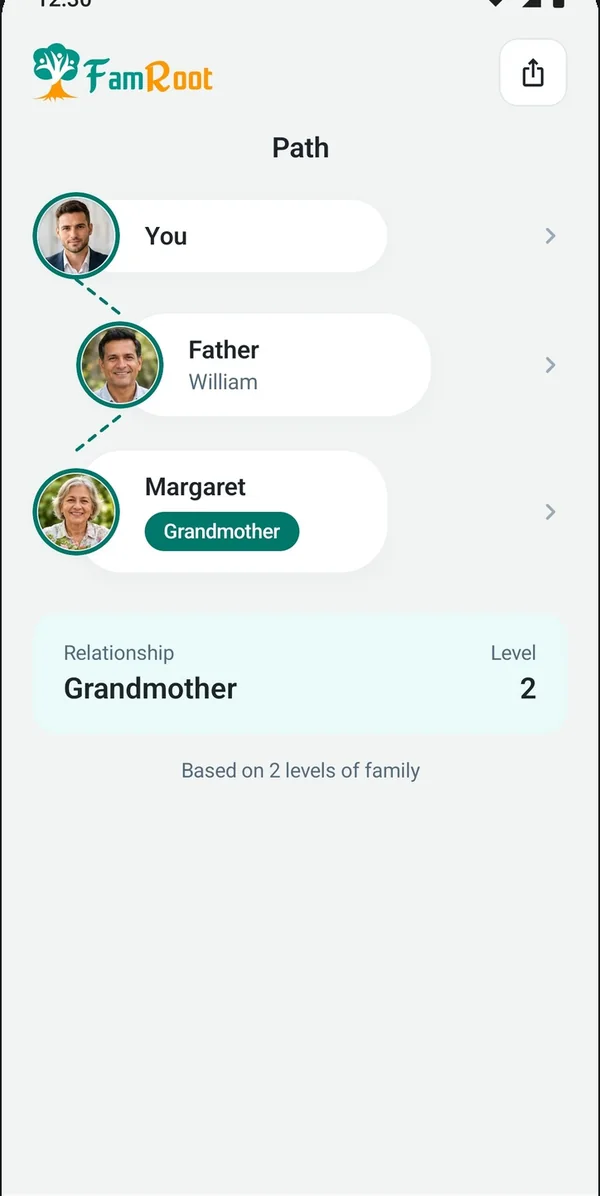
The same path appears on your phone. With Smart Caller ID on Android, a call from a relative in your network shows their name and relationship ("Aunt", "Cousin's wife"), and a tap shows the path. Only the phone number is sent to the server to look up the relationship; call logs stay on the device. Once you know the path, the chart above gives you the word in whichever language the caller expects.
Put the names on a tree. Add your parents, their siblings and your grandparents, invite them, and let FamRoot work out who is whose chittappa. Start building your family tree.